

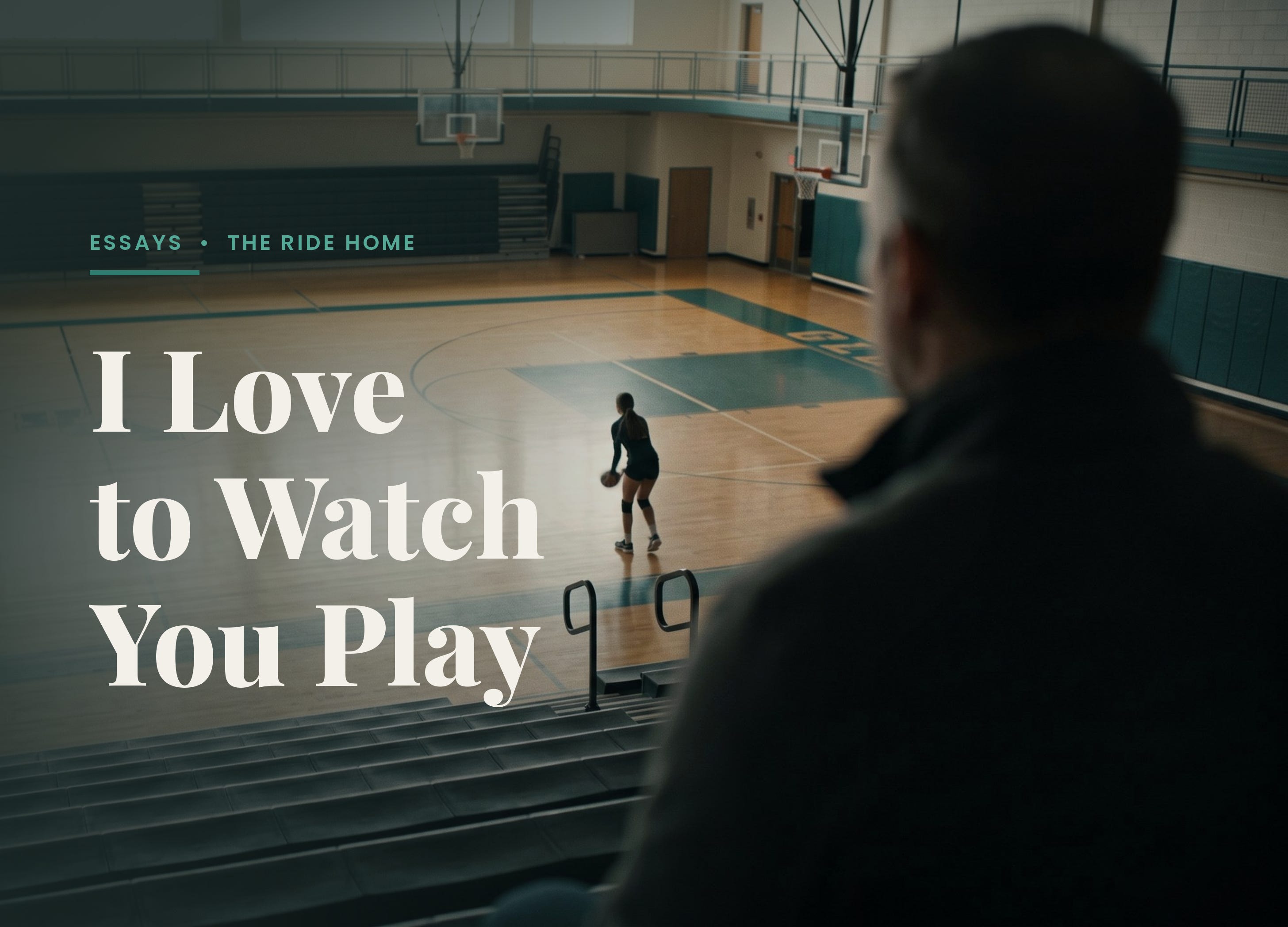
The whistle blows. Players shake hands down the line. Your kid slings a bag over one shoulder and walks across the floor toward you.
You have about ten seconds. You already have something on your mind. Maybe it’s a question about the serve receive, a thought on the rotation, or something about that call you still think was wrong.
I’m a sports parent, same as you — I just read the science so you don’t have to, then hand it back as something you can use by the weekend. Free every Friday.
This week: the one sentence college athletes said they wanted most from their parents, and the research on why it works.
Sunday: The Six-Word Card, a glovebox card for when to say it, how to say it, and what to say when it doesn’t land.
Hold onto that thought. You don’t have to keep it in forever—just wait for one sentence.
Bruce Brown and Rob Miller, who run Proactive Coaching, say they spent about thirty years asking college athletes how their parents supported them — what helped and what didn’t. After hundreds of conversations, one answer stood out. What made athletes happiest wasn’t advice, praise, or a pep talk. It was six words:
“I love to watch you play.”
Just a heads-up: this is an informal survey by practitioners, not a peer-reviewed study. It has no control group or statistics. Brown and Miller are coaches who spent years asking athletes and recording their answers. I won’t say “studies show.” Instead, I’ll share what these coaches heard and then show you the research that explains why it matters.
But first, let’s look at what each word means. This part is my read, not theirs.
I. The sentence is about you, the parent. It isn’t an assessment of her. Nothing in it can be graded.
Love. A feeling, not a verdict.
To watch. Presence. You’re not coaching. You’re witnessing, and the witnessing is the whole job.
You. The kid. Not the team, not the stat line, not the version of her that hit .340 last month.
Play. The verb. Not win. Not perform. Not improve.
Six words, and not one of them knows the score.
Sit with that for a moment, because that’s the main idea.
The research that explains it
Psychologists call love that changes with performance conditional regard. Assor, Roth, and Deci described its emotional costs in a 2004 paper, and Haines and Schutte (2022) later summarized the findings. When affection depends on a child’s performance, it often frustrates the basic psychological needs that help kids stay motivated and connected.
One scope note, so I don’t oversell it. That research isn’t specific to sport, and it isn’t about these six words. It’s about what happens when a child learns that warmth is something you earn.
Now compare the two. Kids don’t need to hear, “I’ll love you more if you win.” They pick it up from the mood in the car, the tone at dinner, or the look on your face after a loss. Conditional regard doesn’t usually announce itself. It just shows.
“I love to watch you play” is the opposite. It’s affection with no strings attached, and a kid can’t read any hidden judgment into it because there isn’t any.
Where it goes sideways
It’s easy to get this wrong, and most of us have. Here are three ways:
The “but.” “I love to watch you play, but…” Everything before the comma just got canceled.
The conditional. “I love to watch you play when you compete like that.” Now it’s a grade, and a kid can hear a grade from across a parking lot.
The follow-up question. You say it, and then you ask. “I love to watch you play. So what happened on that third set?” She hears the question, and the sentence turns out to have been the wrapping paper.
I’ve been practicing this long enough that it’s automatic now. I say it plain. No “but.” No “when you.” And the drive home isn’t a film session. It’s “are you hungry?”
It’s a short sentence, but it’s often the hardest to say when you really want to say something else.
Sunday
On Sunday, I’ll put it in your glovebox. The Six-Word Card covers when to say it, how to make it sound natural, when to hold back, and what to say if she responds, “I played terrible.” It’s a small card meant to stay in the car.
That’s the why, and it’s yours to use. The details on how to do it are coming soon.
You don’t need to understand the game to say it. You just need to have been there, watching.
References
Brown, B. E., & Miller, R. (n.d.). The role of parents in athletics [Booklet]. Proactive Coaching LLC.
https://www.proactivecoaching.ai/
Assor, A., Roth, G. & Deci, E. L. (2004). The Emotional Costs of Parents’ Conditional Regard: A Self‐Determination Theory Analysis. Journal of Personality 72(1), pp. 47-88. https://doi.org/10.1111/j.0022-3506.2004.00256.x
Haines, J. E. & Schutte, N. S. (2022). Parental Conditional Regard: A Meta-Analysis. Journal of Adolescence 95(2), pp. 195-223. https://doi.org/10.1002/jad.12111