

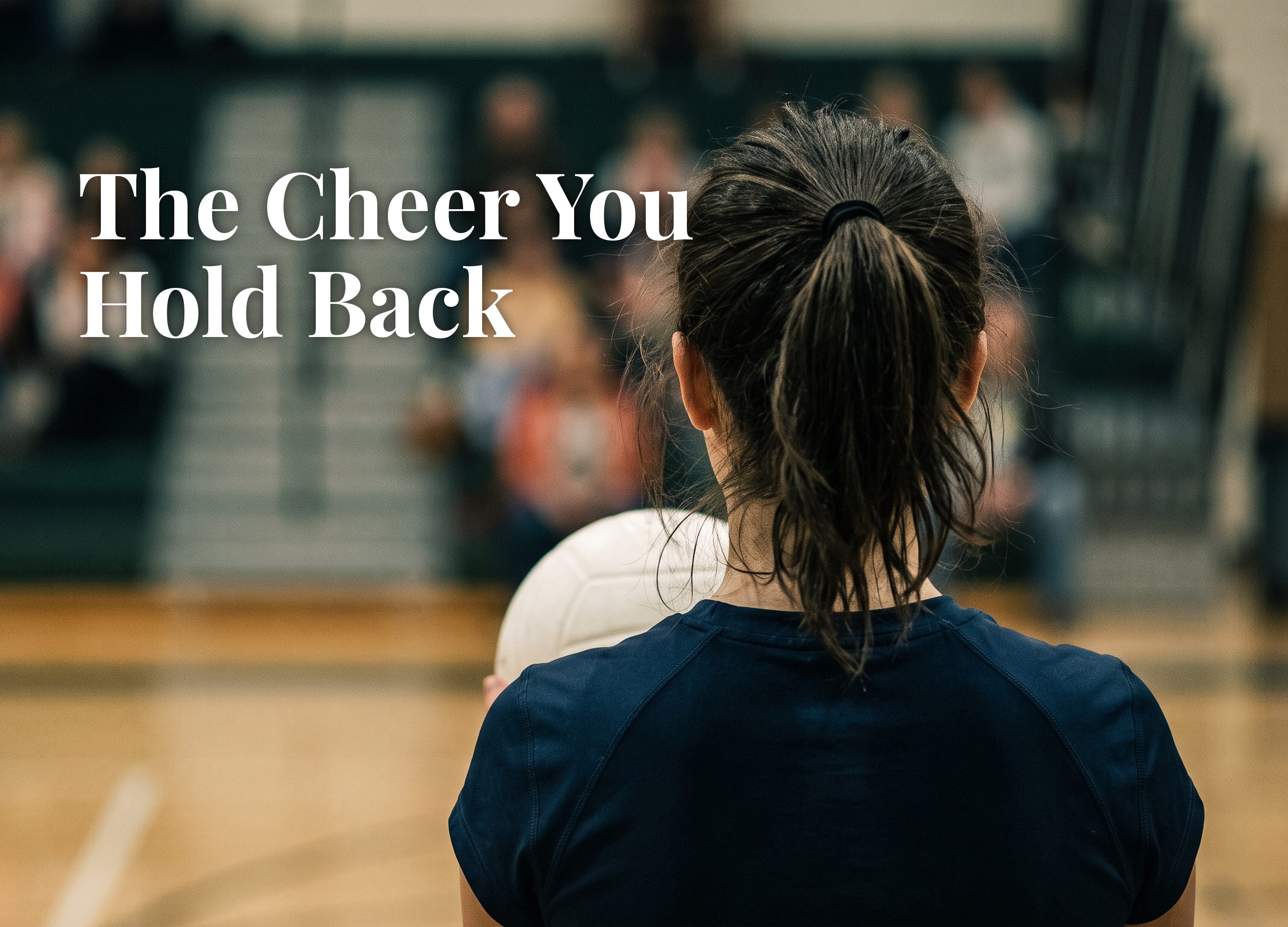
You’re probably sitting three or four rows back. The rally is going, the ball is in play, and players are moving everywhere. Somewhere inside, a word starts to form. Move. Or talk to each other. Or just her name, said sharply, with an instruction riding behind it.
Then you hear it land. And you realize the voice was yours.
It wasn’t the kind of thing we all promise we’ll never do. There was no embarrassment, and the referee didn’t get yelled at. It felt helpful — a small correction, delivered in a friendly way, right when it might help.
That’s the version that gets most of us. Not the screamer. The helper.
Here’s the part you can’t see from the stands.
While you were forming that word, your child was doing one of the hardest things the brain can handle. She was filtering, tracking the ball, reading her opponent, remembering what her coach said in the huddle, and noticing where her own feet were. All the while, she was quickly sorting every new signal to decide if it mattered right then.
Researchers call this kind of focus selective attention (Selective Attention: Filter, Load, and Biased Competition, n.d.). In 1953, Colin Cherry showed that if you put someone in a room full of voices, they can focus on one and tune out the rest. That’s why you can follow a single conversation at a loud party, and why your child can find the ball in a noisy gym.
But this filter isn’t free. Every signal it handles has a cost, even the ones it ignores (Anderson, 2024).
So when your voice comes from the stands during play, it isn’t neutral. It’s another thing she has to filter. She has two choices, and both are tough. She can tune you out, which means you’re talking to a wall. Or she can tune you in, and now she’s juggling two sets of instructions—yours and the coach’s—trying to decide in the moment which one to follow. That choice happens right when instead, she needs to focus on the play.
Not vibes. Mechanics.
I gave that its own chapter in Behind Every Great Student-Athlete. Two playbooks, one kid, one live ball. Something has to give, and it’s usually the play.
This is the main point. There was never any doubt that she can hear you — she can. The real question is what it costs her to listen, and whether your message is worth that cost.
Not all sounds cost the same. There’s a difference between a noise that means do this differently right now, and a noise that just means I’m here. The first needs her full attention. The second can stay in the background—warm, quiet, and costing her nothing.
One of those is a bill. The other is a floor she stands on.
This leads to a simple step, smaller than it seems. From the stands, cheer loudly only when something goes right. Stay quiet the rest of the time.
You don’t have to sit on your hands or go silent. Just avoid being another signal she has to filter, so you can be the one sound that never distracts her.
The hardest kind of encouragement is the one you keep to yourself, because it feels like you’re doing less. It’s actually more difficult, and it’s the better choice, to give your child back her own focus right when she needs it most (Omli & Wiese-Bjornstal, 2011).
Your voice can be the noise she filters out. Or it can be the one sound she never has to.
On Sunday, I’ll share the card that makes holding back automatic — a self-regulation card for your side of the court to use on game day. There’s just one rule and one reset, both small enough to fit in your pocket. I explained the reason above; I’ll reveal the method on Sunday.
I'm a sports parent who reads the research so you don't have to. Free posts like this one explain the why behind the mental game; paid posts hand you the scripts, routines, and worksheets to use at the field and in the car. Subscribe for free to follow along — upgrade any time for the tools.
References
(n.d.). Selective Attention: Filter, Load, and Biased Competition. Cognitive Psychology. https://www.cognitivepsychology.com/Selective_Attention
Cherry, E. C. (1953). Some experiments on the recognition of speech, with one and with two ears. The Journal of the Acoustical Society of America, 25(5), 975–979
Anderson, B. A. (2024). Filtering distractors is costly. Cognition and Emotion 38(5), pp. 834-840. https://doi.org/10.1080/02699931.2024.2324337
Omli, J. & Wiese-Bjornstal, D. M. (2011). Kids Speak: Preferred Parental Behavior at Youth Sport Events. Research Quarterly for Exercise and Sport 82(4), pp. 702-711. https://doi.org/10.1080/02701367.2011.10599807