

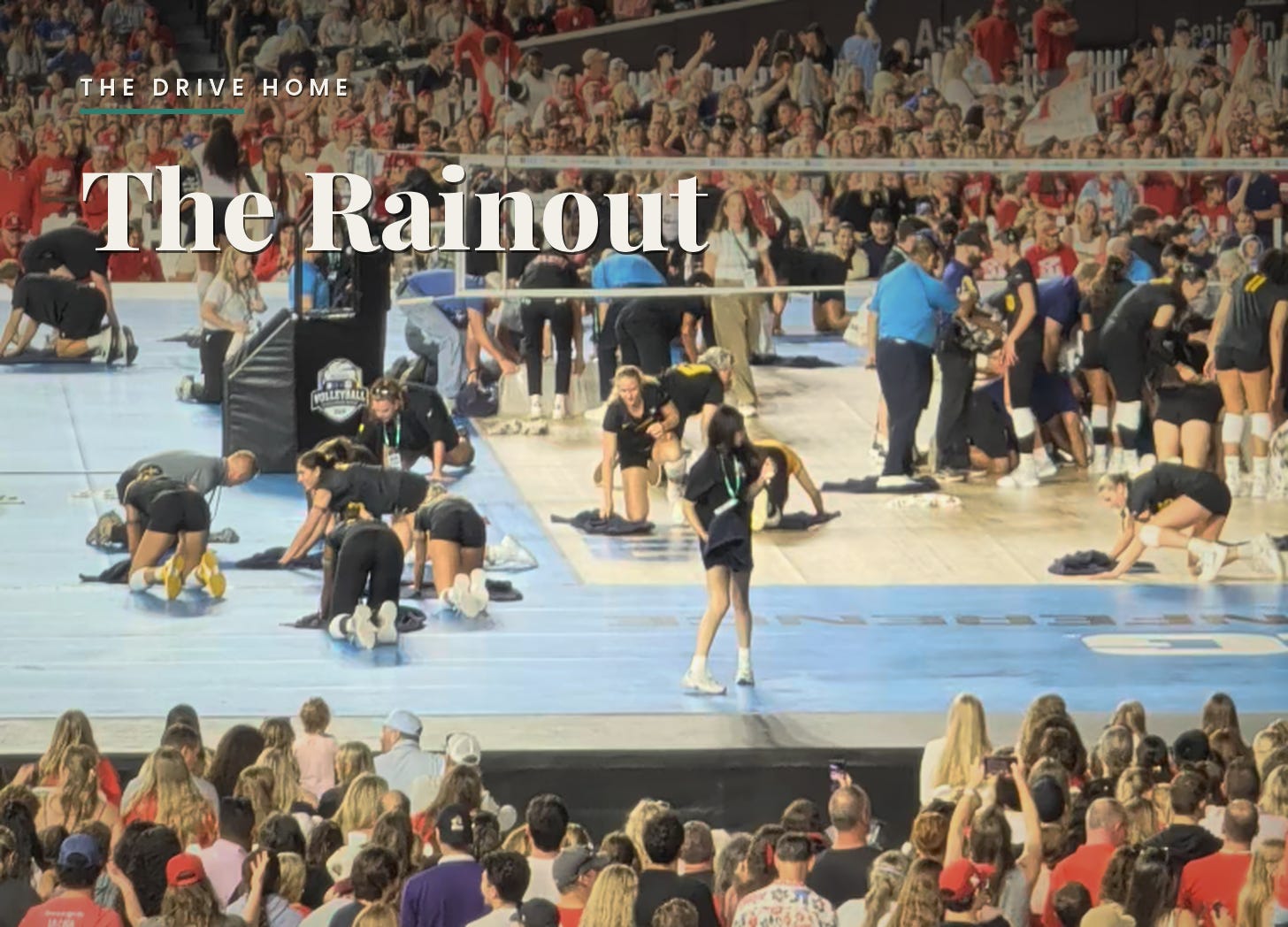
You drive three hours for a tournament, only to have it canceled at the gate. The meet is called off that morning. A referee makes a call that ends the game, and everyone in the gym knows it was wrong. Your kid twists an ankle during warmups and has to watch the game from a folding chair. Or sometimes, the whole thing just disappears, like the volleyball match at Wrigley Field that vanished in front of 43,067 people last weekend when the floor got too wet to play on (Jordan, 2026).
And then you’re in the car with them. And you have no idea what to say.
Here’s why this one is so much harder than a loss.
You can work with a loss. There’s tape to review, something to fix, and another opponent to face. Your whole parent toolkit of advice — shake it off, you’ll get ‘em next time, what did we learn — is made for losses, because a loss gives you something to hold onto.
When a game is taken away, there’s nothing to hold onto. Nobody lost. Nobody choked. There’s no tape to watch, nothing to fix, and no one to blame. It’s just something your kid wanted, gone for a reason that had nothing to do with them. So when you try the usual advice — at least it wasn’t your fault, everything happens for a reason, next one’s yours — it doesn’t help. It feels like you’re not really listening. You’re answering a question they didn’t ask. They’re not looking for a fix. There’s nothing to fix.
So what actually works?
There are two steps, and the order matters most.
First, name it. Don’t fix it. Putting the feeling into simple words helps take some of the sting out; their wiring settles a bit when you name what’s happening instead of trying to manage it (Creswell et al., 2007). Saying, “That’s a gut punch, and it’s not fair” does more than any “at least…” ever could. You’re not saying the world is ending. You’re just agreeing that it stinks. That’s it.
Then — and only when they’re ready — hand back the one thing that’s still theirs. The wet floor wasn’t their fault. The call wasn’t. The cancellation wasn’t. But they still have control over the next hour. How they handle a tough situation is up to them (Rotter, 1966). That’s what those volleyball players did: they couldn’t play, so they grabbed towels, danced, and thanked the crowd. No one fixed the night. They just found what was still theirs (Holt et al., 2007).
Name it first. Then give back that bit of control. If you get the order backward — if you try to move on before they’ve had a chance to be mad — it just sounds like another “shake it off.” Always let them feel first.
That’s the why, and it’s the free part.
I'm a sports parent, same as you — I just read the science so you don't have to, then hand it back as something you can use by the weekend. Free essays every Friday; on Sundays, the tool that turns the idea into words you can actually use — scripts, cards, worksheets — for paid subscribers.
However you read The Drive Home, I'm glad you're here. Not a paid subscriber yet? The Sunday tools, like the card below, are what the paid tier is for.
The hard part is having the right words ready in the car, when you’re tired, they’re hurting, and “at least…” is already on the tip of your tongue.
So here are the words.
Everything above is the why, and it’s yours — share it with the parent standing in a canceled-tournament parking lot this weekend, not knowing what to say.
Below is the what:
The Rainout card — tells you exactly what to say, sorted by the moment you’re in—courtside, on the drive home, that night, or if it keeps happening. It also lists the five reflex phrases to avoid.
The printable Glovebox Edition — one page that folds down to the size of a registration card and fits in your car door pocket.
One starter move to try the very next time.
That’s the equip layer, for paid subscribers.
