

Watch any team long enough, and you’ll see it happen.
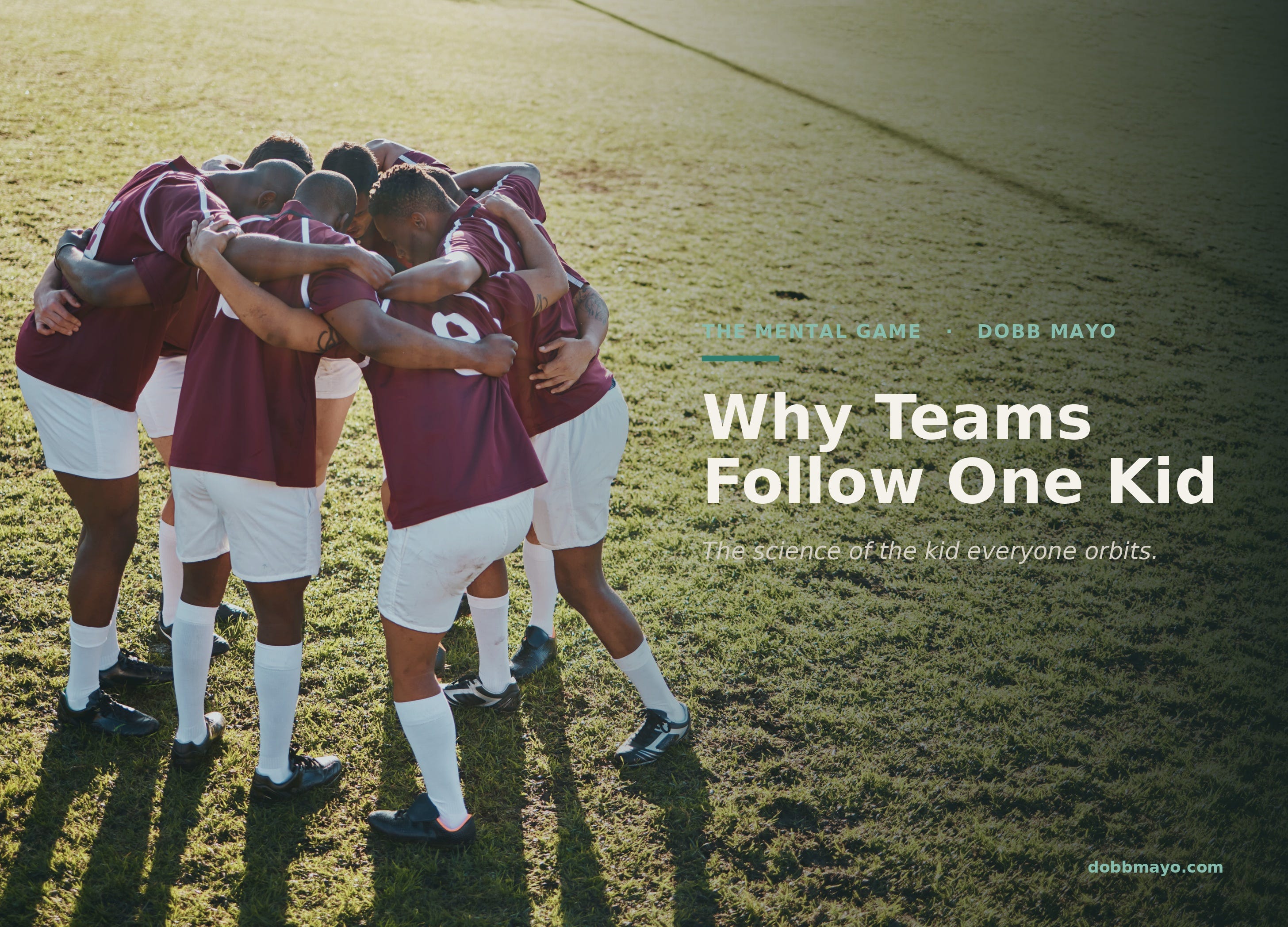
There’s a kid the others orbit. Not always the top scorer. Not always the one with the mouth. But when it gets tight — a bad call, a two-goal hole, the other team going on a run — heads turn, just slightly, toward that one kid. And what happens next in the whole group seems to hinge on what that kid does.
You can probably picture the one on your own kid’s team right now.
The interesting question is why that kid. Because it’s almost never the one the tryout sheet would have picked.
We tend to assume the leader is the loudest, or the best, or the one wearing the captain’s band. Sometimes it’s all three. But strip those away and watch what a rattled team actually does: they reach for something quieter — something the research has a decent idea of what it is.
Here’s the first piece. When sport psychologists went looking for what holds a team together, they found that the coach isn’t the only one steering it. Athlete leadership — the influence that comes from a teammate, not an adult — turns out to be a real force in how connected and cohesive a team remains under pressure (Loughead & Hardy, 2005). Some of the glue is coming from a kid. The team is being led from the inside, whether or not anyone named that kid a captain.
So what is that kid doing that the others aren’t?
Mostly, they’re regulating the temperature.
A team is an emotional system, and emotion in a group is contagious — it spreads from body to body faster than anyone decides to let it (Eldadi et al., 2023). One kid’s panic ripples out and becomes six kids’ panic. One kid’s steadiness does the same thing in the other direction. The kid the team follows is usually the one whose settings the group borrows: the one who, when the call goes the wrong way, doesn’t spike — so nobody around them spikes either.
That’s not a personality trait you’re born loud enough to have. It’s closer to a skill. The athletes who do it well tend to score higher on what researchers call emotional intelligence — the ability to read what they’re feeling, read what the people around them are feeling, and manage both instead of getting swept along (Cowden, 2016). They feel the same two-goal-deficit dread as everyone else. They just don’t hand it to the rest of the team.
Which reframes what you’re watching from the bleachers. The kid the others follow isn’t the one who takes over. It’s the one who makes everyone else steadier to stand next to.
And here’s the part that matters most if the kid the team follows isn’t yours — at least not yet: you can still build it.
Emotional intelligence isn’t fixed. It’s one of the more teachable things in sport psychology — built through unglamorous practice, like noticing your reactions after a game and asking what set them off. Most kids are just never shown that it’s a skill at all — they think you either have “it” or you don’t, and decide early that they don’t (Chang, 2006).
They’re wrong about that. And that’s most of the book I’ve spent the last year writing.
his Sunday, the paid piece turns this into something you can actually use — a self-audit that helps a young athlete see which of these steadying skills they already have and which one to build next. That’s the payoff in practice. And on Thursday, the whole framework arrives: Leadership for Student-Athletes launches, with a founding-member offer for everyone here first.
The kid teams follow can be built. Let’s show you how.
References
Loughead, Todd M., Hardy, James. (2005). An examination of coach and peer leader behaviors in sport. Psychology of Sport and Exercise, 6(3), 303-312. https://doi.org/10.1016/j.psychsport.2004.02.001
Eldadi, O., Sharon-David, H., & Tenenbaum, G. (2023). Interpersonal emotions in team sports: Effects of emotional contagion on emotional, social and performance outcomes of a team. Scientific Journal of Sport and Performance, 2(4), 473–491. https://doi.org/10.55860/KCDX3917
Cowden, R. G. (2016). Mental Toughness, Emotional Intelligence, and Coping Effectiveness: An Analysis of Construct Interrelatedness Among High-Performing Adolescent Male Athletes: An Analysis of Construct Interrelatedness Among High-Performing Adolescent Male Athletes. Perceptual and Motor Skills, 123(3), 737-753. https://doi.org/10.1177/0031512516666027
Chang, Kelly B.T., “Can We Teach Emotional Intelligence?” (2006). Faculty Publications - Psychology Department. 45. https://digitalcommons.georgefox.edu/psyc_fac/45